What Has 4 Letters Sometimes 9 But Never Has 5

holaforo
Mar 12, 2026 · 7 min read
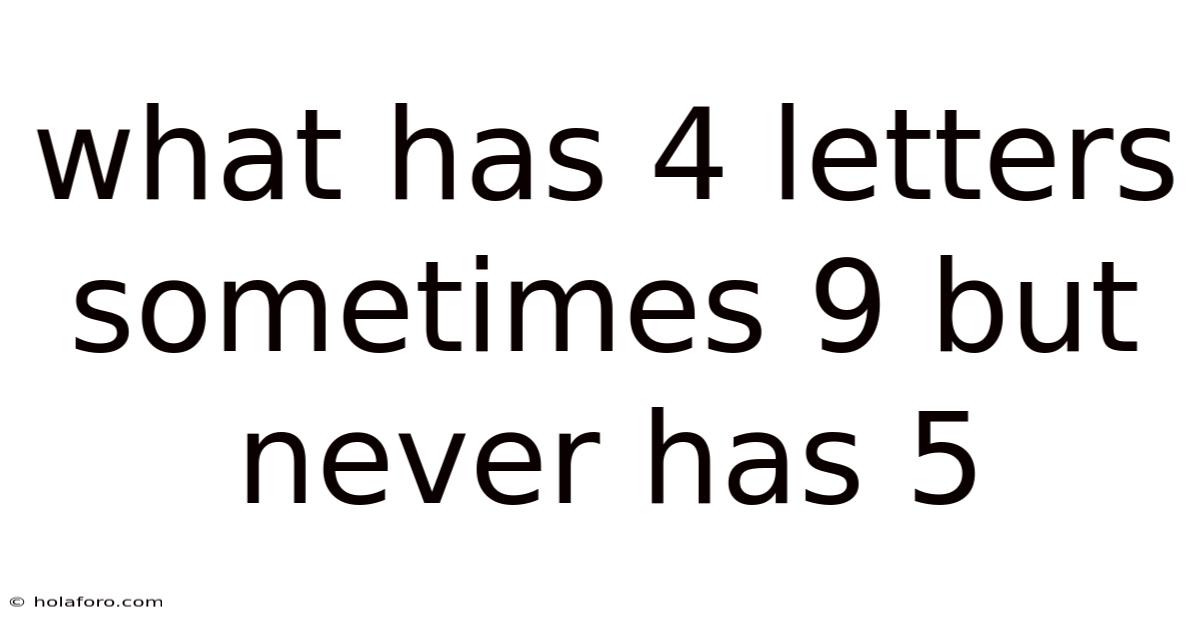
Table of Contents
What Has4 Letters Sometimes 9 But Never Has 5?
Riddles have long captivated human curiosity, blending logic, language, and creativity into a single puzzle. One such enigmatic question that has puzzled minds for generations is: “What has 4 letters sometimes 9 but never has 5?” At first glance, it seems like a paradox, but the answer lies in the clever interplay of words and their hidden meanings. This riddle is a classic example of how language can be both playful and profound, inviting solvers to think beyond literal interpretations. Let’s dive into the layers of this linguistic conundrum and uncover why “time” is the universally accepted solution.
Breaking Down the Riddle
To solve the riddle, we must analyze each component of the question:
- “What has 4 letters”: This part asks for a word that contains exactly four letters.
- “Sometimes 9”: The same word must also have nine letters in another form or context.
- “Never has 5”: The word must never have five letters under any circumstances.
At first, these conditions appear contradictory. How can a single word have four letters, nine letters, and never five? The key lies in interpreting the riddle not as a literal description of letters but as a metaphorical or contextual puzzle.
The Answer Revealed: “Time”
The solution to the riddle is “time”. Let’s dissect how this word satisfies all three conditions:
- Four Letters: The word “time” itself is spelled with four letters: T-I-M-E.
- Sometimes Nine: When combined with the word “sometimes”, the phrase “sometimes time” contains nine letters (S-O-M-E-T-I-M-E-S).
- Never Five: The word “time” never contains five letters in any form. Even when paired with other words, it retains its four-letter structure.
This clever wordplay hinges on the dual meaning of “sometimes” as both a temporal adverb and a component of the nine-letter phrase. The riddle tricks the solver into focusing on individual words rather than their combined meanings.
Why “Time” Fits Perfectly
The word “time” is a masterclass in linguistic flexibility. It serves as a noun, verb, and concept, making it a versatile answer to riddles. Here’s why it works so well:
- Literal Interpretation: As a standalone word, “time” has four letters.
- Contextual Expansion: When paired with “sometimes”, it forms a nine-letter phrase that still references the concept of time.
- Exclusion of Five Letters: No variation of “time” (e.g., “times”, “timed”) adds up to five letters. Even plural or past-tense forms deviate from the five-letter constraint.
This riddle exemplifies how language can bend and stretch to create humor, confusion, and insight. It’s no wonder that “time” has become the gold standard for such puzzles.
Historical and Cultural Context
Riddles like this one have roots in ancient traditions, where wordplay was a cornerstone of oral storytelling and education. In many cultures, riddles were used to teach children about language, logic, and critical thinking. For example:
- Ancient Greece: Philosophers like Aristotle used riddles to explore abstract concepts.
- Middle Ages: Monks crafted riddles to pass time during long journeys.
- Modern Puzzles: Today, riddles appear in escape rooms, brain teasers, and even viral social media challenges.
The “time” riddle, in particular, has been featured in countless books, websites, and educational materials. Its simplicity and universal appeal make it a timeless favorite.
Similar Riddles and Wordplay
If you enjoy this riddle, you’ll love these related puzzles:
- “What has a head, a tail, is brown, and has no legs?”
Answer: A penny (or any coin). - “What has keys but can’t open locks?”
Answer: A piano.
Beyond the classic “time” example, letter‑count riddles thrive on the tension between a word’s intrinsic length and the length of the phrase it inhabits. Consider the word “sea.” On its own it boasts three letters, yet when coupled with the adverb “often” the resulting phrase “often sea” stretches to eight letters — still shy of the coveted nine, but illustrating how a modest base can be inflated by a qualifying modifier. Conversely, the word “light” resists any attempt to hit exactly five letters when paired with common qualifiers; “bright light” totals eleven, while “soft light” lands at nine, never collapsing to the forbidden five‑letter mark.
Another fertile ground for this type of play is the realm of homophones. Take “write.” Standing alone, it comprises five letters, but when preceded by the negation “not” the phrase “not write” expands to nine letters, while the core term never drops below five regardless of tense (“writes,” “written,” “writing”). The riddle hinges on the solver’s expectation that the modifier will alter the base word’s count, only to reveal that the base remains stubbornly anchored to its original length.
These puzzles underscore a broader linguistic principle: language is simultaneously rigid and pliable. The fixed orthographic skeleton of a word provides a stable anchor, while syntactic context lets us stretch or compress the surrounding expression. This duality makes letter‑count riddles an excellent mental workout — they sharpen attention to detail, encourage flexible thinking, and delight in the surprise when the obvious answer is revealed.
In everyday life, similar patterns appear in advertising slogans, hashtags, and even password policies, where creators deliberately juggle character limits to convey meaning within strict constraints. Recognizing the tricks behind such constraints not only aids in solving riddles but also fosters a deeper appreciation for the craftsmanship embedded in concise communication.
Conclusion:
The enduring appeal of riddles like the “time” puzzle lies in their ability to turn a simple counting exercise into a window onto the structure of language itself. By juxtaposing an immutable word length with mutable phrasing, they invite us to explore how meaning can be both fixed and fluid — a reminder that even the most straightforward elements of speech can conceal layers of cleverness waiting to be uncovered. Whether you’re a seasoned puzzler or a curious newcomer, the next time you encounter a letter‑count challenge, pause to consider the interplay between the word’s core and its context; the answer often hides in plain sight, ready to illuminate the playful logic that underlies our everyday words.
This interplay between stability and variability also manifests in morphological constraints. Consider the word “strength.” Its eight-letter core is immutable, yet adding a suffix like “-en” (“strengthen”) yields ten letters, while a prefix such as “un-” (“unstrength”) is rare but would produce eleven. The puzzle’s logic exploits the solver’s instinct to seek a transformation that reduces the count, when in fact the base word acts as an unyielding anchor. Similarly, with “through,” six letters resist compression; “get through” totals ten, “break through” twelve—never collapsing to a target length that would satisfy a naïve counting strategy.
Such patterns reveal how our brains automate parsing: we instinctively segment phrases into content words and modifiers, yet the riddle subverts this by treating the entire string as a single countable unit. This cognitive tension—between syntactic decomposition and holistic perception—is what makes the solution both elusive and satisfying. It mirrors real-world challenges like fitting a tweet into 280 characters or crafting a memorable domain name, where every character must earn its place.
In computational linguistics, these principles inform algorithms for text summarization and poetry generation, where systems must balance semantic integrity with formal constraints. Even in music, lyricists count syllables to match melodic lines, relying on the same elasticity between core words and decorative phrases. Recognizing this elasticity equips us to navigate not just puzzles but any medium where form and content are locked in negotiation.
Ultimately, these letter‑count riddles are more than word games; they are microcosms of linguistic resilience. They demonstrate that while meaning may shift with context, the orthographic skeleton of a word remains a steadfast reference point—a quiet constant amid the dance of syntax. This duality invites us to look past the surface of
language, to see how even the most rigid structures can bend without breaking, and how the constraints we impose can spark creativity rather than stifle it. In every puzzle, poem, or tweet, we are reminded that words are not just vessels for meaning—they are also puzzles in themselves, waiting to be rearranged, reimagined, and reveled in. The next time you encounter a linguistic challenge, remember: the answer may not lie in changing the word, but in changing the way you see it.
Latest Posts
Latest Posts
-
Map Of North Carolina Towns And Cities
Mar 12, 2026
-
Is The Dominican Republic A United States Territory
Mar 12, 2026
-
Flags Similar To The Us Flag
Mar 12, 2026
-
Map Of Africa With Mt Kilimanjaro
Mar 12, 2026
-
How Many Different Types Of Penguins Are There
Mar 12, 2026
Related Post
Thank you for visiting our website which covers about What Has 4 Letters Sometimes 9 But Never Has 5 . We hope the information provided has been useful to you. Feel free to contact us if you have any questions or need further assistance. See you next time and don't miss to bookmark.
