What Has 4 Letters Sometimes 9

holaforo
Mar 16, 2026 · 8 min read
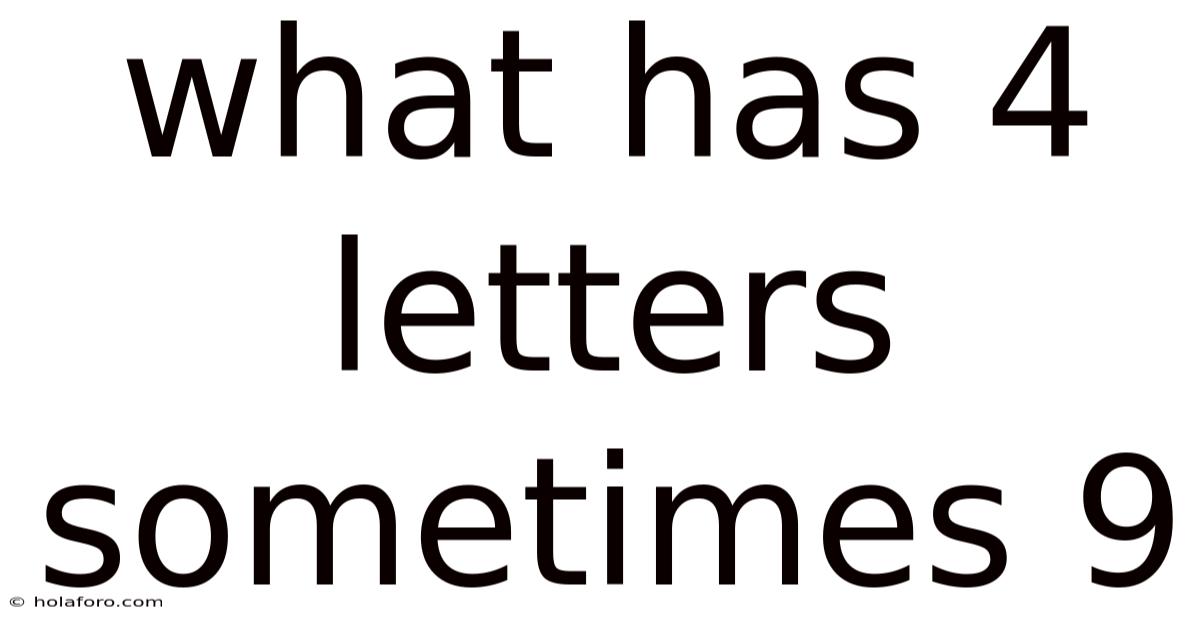
Table of Contents
What Has 4 Letters Sometimes 9
The riddle "What has 4 letters, sometimes 9?" is a classic brain teaser that has puzzled many over the years. This riddle is a great example of how language can be both playful and perplexing. The answer to this riddle is "what." The word "what" has four letters, and the phrase "sometimes 9" refers to the word "what" in the context of the riddle itself, which has nine letters. This riddle is a clever play on words that highlights the intricacies of the English language.
Understanding the Riddle
To fully appreciate the riddle, it's essential to break it down into its components. The riddle states that there is something with four letters, but it also mentions that it can have nine letters. This seems contradictory at first glance, but the key lies in the phrase "sometimes 9." The word "what" itself has four letters, but when you include it in the context of the riddle, the entire phrase "what has 4 letters sometimes 9" contains nine letters. This clever twist makes the riddle both amusing and thought-provoking.
The Art of Riddles
Riddles have been a part of human culture for centuries. They serve multiple purposes, from entertainment to educational tools. Riddles like "what has 4 letters sometimes 9" challenge the mind and encourage critical thinking. They often require a shift in perspective to solve, making them an excellent way to exercise the brain. Riddles can be found in various forms of literature, from ancient texts to modern puzzles, and they continue to captivate people of all ages.
Types of Riddles
Riddles come in many forms, each with its unique characteristics. Some common types include:
- Word Play Riddles: These riddles rely on the manipulation of language, such as puns, homophones, and double meanings. The riddle "what has 4 letters sometimes 9" falls into this category.
- Logic Riddles: These riddles require logical reasoning to solve. They often present a scenario and ask for a solution based on the given information.
- Math Riddles: These riddles involve mathematical concepts and require solving equations or puzzles.
- Picture Riddles: These riddles use visual elements to convey a message or present a puzzle to be solved.
The Science Behind Riddles
Riddles engage various parts of the brain, making them an effective tool for cognitive development. When solving a riddle, the brain activates areas associated with language processing, problem-solving, and critical thinking. This mental exercise can improve memory, enhance creativity, and even boost problem-solving skills. Riddles also promote lateral thinking, which involves looking at problems from different angles and considering unconventional solutions.
Benefits of Solving Riddles
Solving riddles offers several benefits, including:
- Improved Cognitive Function: Riddles stimulate the brain, helping to improve memory, concentration, and overall cognitive function.
- Enhanced Problem-Solving Skills: Riddles require creative thinking and the ability to approach problems from different perspectives.
- Increased Creativity: Riddles encourage out-of-the-box thinking, which can foster creativity and innovation.
- Stress Relief: Engaging in mental puzzles can be a relaxing and enjoyable way to unwind, reducing stress and anxiety.
Famous Riddles Throughout History
Riddles have been a part of human culture for thousands of years. Some of the most famous riddles come from ancient texts and folklore. Here are a few notable examples:
- The Riddle of the Sphinx: In Greek mythology, the Sphinx asked travelers a riddle to allow them to pass. The riddle was, "What walks on four feet in the morning, two in the afternoon, and three in the evening?" The answer is "man," who crawls on all fours as a baby, walks on two legs as an adult, and uses a cane in old age.
- The Riddle of the Three Switches: This riddle involves three light switches outside a closed room, each controlling one of three light bulbs inside the room. The task is to determine which switch controls which bulb in only one entry into the room. The solution involves turning on one switch, waiting a few minutes, turning it off, and then turning on another switch before entering the room.
- The Riddle of the Egg: This riddle asks, "Which came first, the chicken or the egg?" The answer lies in the understanding of evolution and the fact that the first chicken evolved from a bird that was not a chicken, laying an egg that hatched into the first chicken.
How to Create Your Own Riddles
Creating your own riddles can be a fun and rewarding activity. Here are some tips to help you get started:
- Choose a Theme: Decide on the subject or theme of your riddle. It could be anything from animals to everyday objects.
- Use Word Play: Incorporate puns, homophones, and double meanings to make your riddle more challenging and entertaining.
- Be Clear and Concise: Ensure your riddle is easy to understand but difficult to solve. Avoid ambiguity and ensure the answer is unique.
- Test Your Riddle: Share your riddle with friends or family to see if they can solve it. Gather feedback and make any necessary adjustments.
FAQ
What is the purpose of riddles?
Riddles serve multiple purposes, including entertainment, education, and mental stimulation. They challenge the mind and encourage critical thinking, making them an excellent tool for cognitive development.
How do riddles benefit the brain?
Riddles engage various parts of the brain, including areas associated with language processing, problem-solving, and critical thinking. They can improve memory, enhance creativity, and boost problem-solving skills.
What are some famous riddles?
Some famous riddles include the Riddle of the Sphinx from Greek mythology, the Riddle of the Three Switches, and the Riddle of the Egg.
How can I create my own riddles?
To create your own riddles, choose a theme, use word play, be clear and concise, and test your riddle with others to gather feedback.
Conclusion
The riddle "what has 4 letters sometimes 9" is a classic example of how language can be both playful and perplexing. It highlights the intricacies of the English language and the art of riddles. Riddles have been a part of human culture for centuries, serving as tools for entertainment, education, and mental stimulation. They engage various parts of the brain, promoting cognitive development and creativity. Whether you're solving riddles or creating your own, they offer a fun and rewarding way to exercise the mind. So, the next time you encounter a riddle, embrace the challenge and enjoy the mental workout it provides.
Continuing the explorationof riddles, their creation, and their enduring appeal, we delve into the fascinating intersection of language, logic, and human ingenuity. The Riddle of the Egg, while seemingly simple, encapsulates a profound truth about evolution and the nature of beginnings, demonstrating how riddles can provoke deep thought beyond mere wordplay. This intellectual engagement is a core strength of the riddle form.
Moving beyond solving, the art of creating your own riddles offers a powerful avenue for personal expression and cognitive exercise. It demands a deep understanding of language, a playful manipulation of meaning, and a keen sense of what makes a puzzle both challenging and satisfying. The tips provided – choosing a theme, employing word play, striving for clarity and conciseness, and rigorously testing – form a solid foundation. However, the true essence lies in the creator's unique perspective and the joy of crafting a mental challenge that sparks that "aha!" moment in another.
The FAQ section underscores the multifaceted value of riddles. They are not merely trivial amusements; they are potent tools for entertainment, providing shared moments of laughter and intellectual camaraderie. They serve as educational instruments, subtly reinforcing vocabulary, concepts, and critical thinking skills. Most significantly, they act as mental stimulants, engaging diverse cognitive functions – from linguistic processing and memory retrieval to complex problem-solving and creative leaps. This holistic brain workout is why riddles have persisted across cultures and centuries.
Famous riddles like the Riddle of the Sphinx, the Riddle of the Three Switches, and the Riddle of the Egg stand as testaments to this enduring power. They transcend their immediate solutions, often embodying cultural myths, philosophical questions, or ingenious logical puzzles that continue to captivate and challenge solvers. The Riddle of the Egg, in particular, bridges ancient myth with modern scientific understanding, highlighting riddles' unique ability to frame complex ideas in accessible, thought-provoking ways.
Ultimately, the journey through riddles – from solving the enigmatic to crafting the clever, from understanding their purpose to appreciating their famous examples – reveals them as a timeless human activity. They are a mirror reflecting our love for language, our fascination with the unknown, and our innate drive to solve puzzles. Whether encountered in ancient texts, modern puzzles, or created spontaneously in conversation, riddles offer a unique and rewarding way to engage the mind, connect with others, and appreciate the intricate beauty of thought itself. They remind us that the search for answers, wrapped in layers of wit and wisdom, is a fundamental and joyful part of the human experience.
Latest Posts
Latest Posts
-
Map Of Rocky Mountains In Usa
Mar 16, 2026
-
Photos From The Top Of Mount Everest
Mar 16, 2026
-
United States Map States And Capitals
Mar 16, 2026
-
What Has 4 Letters Sometimes 9 Letters Answer
Mar 16, 2026
-
Map Of Cape Horn South America
Mar 16, 2026
Related Post
Thank you for visiting our website which covers about What Has 4 Letters Sometimes 9 . We hope the information provided has been useful to you. Feel free to contact us if you have any questions or need further assistance. See you next time and don't miss to bookmark.
